

Lea Majaro-Mintz - Biography
1. Formative Years and Illustrious Roots in Jerusalem (1926-1949) - Majaro-Mintz was born in 1926 in the heart of the Old City of Jerusalem, a setting whose ancient stones, deep history, and layered textures would permanently shape her artistic consciousness. She grew up in an extraordinary, culturally rich home that bridged deep pioneering roots with European intellectualism.

Lea on the right and Dalia Gardinger, the daughter of her aunt Miriam

Lea and her brother Simon
Her father, Dr. Leon Majaro, was an Odessa-born physician who immigrated to the Land of Israel and established vital medical clinics in Lod after World War I, and later in the Old City of Jerusalem. He served as a dedicated senior physician at the historic Bikur Holim Hospital until the medical staff and residents were forced to evacuate during the 1948 War of Independence.

The Bikur Cholim Hospital in the Old City of Jerusalem
Her mother, Hannah, was the daughter of the historic builder Shimon Rokeach, and an accomplished classical pianist who had pursued her advanced musical education at the prestigious Conservatory of Lausanne in Switzerland.

Hanna and Leon, Lea's parents, on the cover of the book written by Leon Majaro and translated into English by Simon Majaro, Lea's brother

She pursued her formal education at the prestigious Hebrew Gymnasia in Rehavia, graduating in 1943.
Driven by a dual passion for intellectual structure and visual expression, she balanced two demanding fields of study, completing her law degree at the Hebrew University on Mount Scopus while simultaneously refining her creative talents at the Bezalel Academy of Arts and Design, graduating in 1949.

Lea with her class, seated first from the left
2. Deep Roots: An Eighth-Generation Israeli Lineage Lea represented the eighth generation of her family born in the Land of Israel, carrying a deeply rooted historical legacy. On her maternal side, she was a direct descendant of Rabbi Israel Bak of Safed, the pioneering printer who established the first modern agricultural farm in Israel since the exile.

Israel Bak, printer, publisher, and editor of the Havatzelet newspaper, founder of the farm on Mount Meron, and head of the Sadigura-Chabad Hasidic community in Israel, who immigrated to Israel from Berdychiv in 1832; grandfather of Shimon Rokach, Lea's grandfather

The Tiferet Yisrael Synagogue, established for the Hasidic community in the Jewish Quarter in 1872 by Israel Bak and his son Nissan Bak. The synagogue was blown up by the Arab Legion after the capture of the Jewish Quarter and has only recently been undergoing reconstruction.
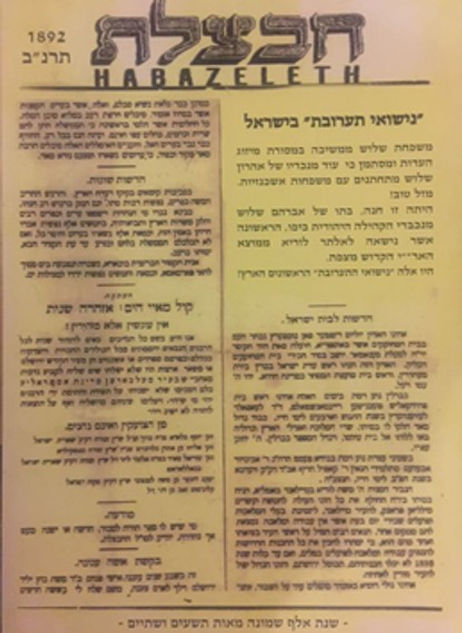
She was also a descendant of Rabbi Eleazar Rokeach of Amsterdam, author of the profound rabbinical commentary "Ma'aseh Rokeach," who ascended to the Land of Israel in 1740 and was appointed President of the Holy Land (and whose descendants include the Grand Rabbis of the Belz Hasidic dynasty to this day).

The opening page of the book Ma'aseh Rokeach, published by Rabbi Eleazar Rokach during his tenure as the Chief Rabbi of Amsterdam. The Rabbi immigrated to Safed and was appointed President of the Holy Land in 1740. His descendants include the dynasty of the Belz Hasidic Rebbes on one side, and Shimon Rokach (founder of Neve Tzedek in 1887) and Eleazar Rokach (founder of Gei Oni in 1875, later Rosh Pinna) on the other.
This rich heritage culminated in her grandfather, Shimon Rokeach, who became one of the historic founders and builders of the Neve Tzedek neighborhood in Tel Aviv, where Lea would later center her life's work.

A ceramic tile plaque on the wall at the Suzan Dallal Center plaza in Neve Tzedek. The founder, Shimon Rokach (1863–1922), is in the center, surrounded by Amzalleg, Barnat, and Shalosh (from right to left).
3. Legal Career and a Transition to the Arts Following her graduation, Lea embarked on a successful career in the legal field. She practiced law with distinction for ten years, establishing herself professionally before eventually choosing to dedicate her life entirely to her true passion-art, education, and sculpture.

An article in Hebrew from the Maariv newspaper, 1962, describing Lea's transition from a successful law practice to pursuing art full-time
The titles
The lawyer exchanged her robe for a paintbrush She defended Abu Ghosh and is now holding an exhibition in Tel Aviv
Her commitment to the arts extended into higher education and mentorship. Throughout her active career, she served as a dedicated educator, shaping future generations of artists and teachers at several of Israel's premier institutions, including the Bezalel Academy of Arts and Design, Bar-Ilan University, and the David Yellin College of Education.

A letter of recommendation in Hebrew to the Dean of the Faculty of Humanities at Bar-Ilan University from Avraham Even-Shoshan, regarding her work at the David Yellin Seminar in Jerusalem, where he served as director since 1965

A letter of thanks, 1964, from the director of Bezalel, Mr. Felix Darnell, regarding Lea's work at the academic institution of arts
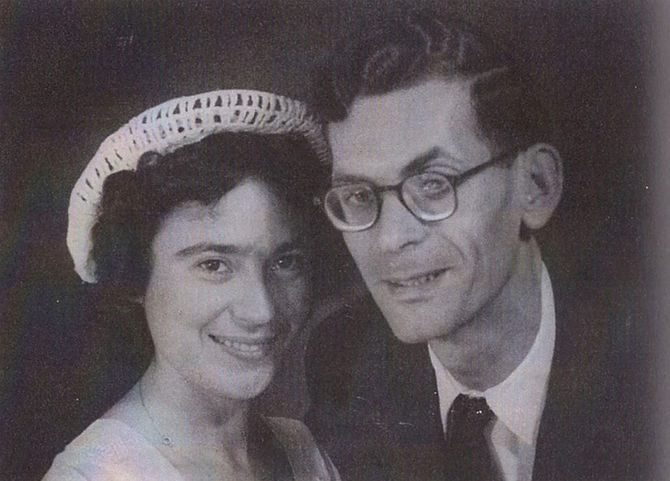

Isaac Mintz, 1957, Geneva

who was then engaged at Harvard University in designing the engineering and structural infrastructure for the future Ashdod Port. Separately, exploring her narrative creativity, she published her beloved children's coloring book, "Yotam and his Donkey Balaam" (1956), displaying her early ability to bridge storytelling and visual form.
Her global perspective deepened significantly in 1963, when she spent an extended period in Nairobi during Kenya's historical transition to independence.

A congratulatory letter to Lea from the Foreign Minister at the time, Mrs. Golda Meir, regarding her exhibition in Ethiopia


Lea in her studio, mid-1960s
The vibrant cultural shift left a lasting impression on her work. Upon her return, following the unification of Jerusalem in 1967, she channeled her deep connection to her birthplace into the creation of "The Kotel Album," capturing the spiritual and physical gravity of the city's ancient stone walls.

A sketch from the album of the Western Wall parade, 1967

Moshe Dayan, the Minister of Defense, signing the Western Wall album, 1967

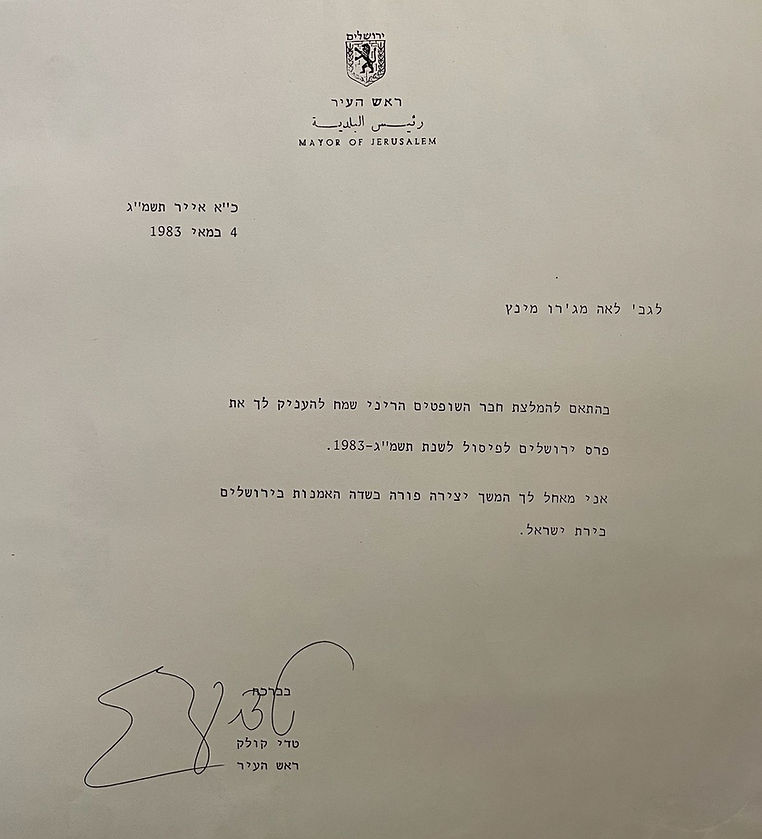
The awarding of the Jerusalem Prize for Sculpture by the Mayor, Mr. Teddy Kollek, 1983


A letter from the municipality with the reasons for awarding the prize to Lea


A mention in the Jerusalem Post newspaper about the awarding of the prize
In 1986, her distinctive approach was showcased in a widely acclaimed 27-minute documentary directed by Eitan Wetzler. Released also in an English version, the film achieved immense international popularity and was screened to audiences in Israel and across the globe, bringing her unique artistic vision to the forefront of the cultural conversation.
5. The Philosophy of Clay: "Conversations in Clay" The definitive turning point in Lea's public artistic legacy came in 1980 with the publication of her seminal book, "Conversations in Clay." Written and presented concurrently in both Hebrew and English, the book achieved widespread acclaim and earned the prestigious "Beautiful Book of Israel" award at the International Book Fair in 1981. Due to its lasting impact, a second edition was published in 1987.
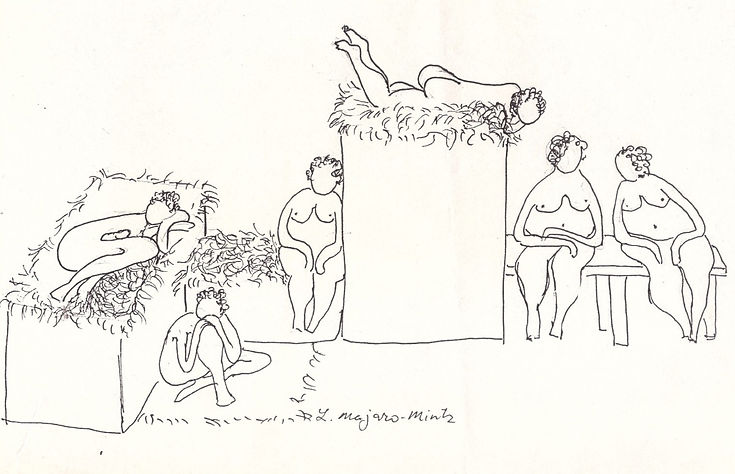
Through this work, Lea articulated a profound and highly original feminist aesthetic. Her sculptures did not depict women through an external, idealized male gaze; rather, she sculpted women as they experienced themselves from the inside out. Her figures inhabit a space of ultimate domestic relaxation, capturing moments of profound rest after labor, completely free from societal pretense.
Her approach to materials was deeply organic. Lea rejected rigid separation between art and environment, integrating her sculpted women directly into the domestic architecture-allowing them to rest on floors, support ceilings, lounge across armchairs, or blend seamlessly into shelves and staircases. In her view: "The clay breathes life and softness into the walls of cold, rigid stone. I feel the woman from the inside."

Lea with her artworks in the sculpture garden she created, early 1970s
6. Global Projections and Prestige (1990) The year 1990 marked a major milestone in Lea's international recognition. Her family opened a dedicated art gallery for her work, named ArtINN, located in the heart of New York City's vibrant art scene at the corner of West Broadway and Broome Street.

The brochure for Lea's gallery exhibition in New York, 1991

The gallery facade in New York at the corner of West Broadway and Broome Streets
During that same landmark year, Lea was invited to exhibit her work at the prestigious National Museum of Women in the Arts (NMWA) in Washington, D.C., where several of her pieces were permanently acquired and remain part of the museum's esteemed collection. Concurrently, she held a major solo exhibition in London on Bond Street, hosted by a prominent gallery that specialized primarily in the historic drawings of Rembrandt-a testament to the classical and structural rigor recognized in her contemporary creations.

The Invitation for Lea's exhibition in London

The gallery facade in London on Bond Street

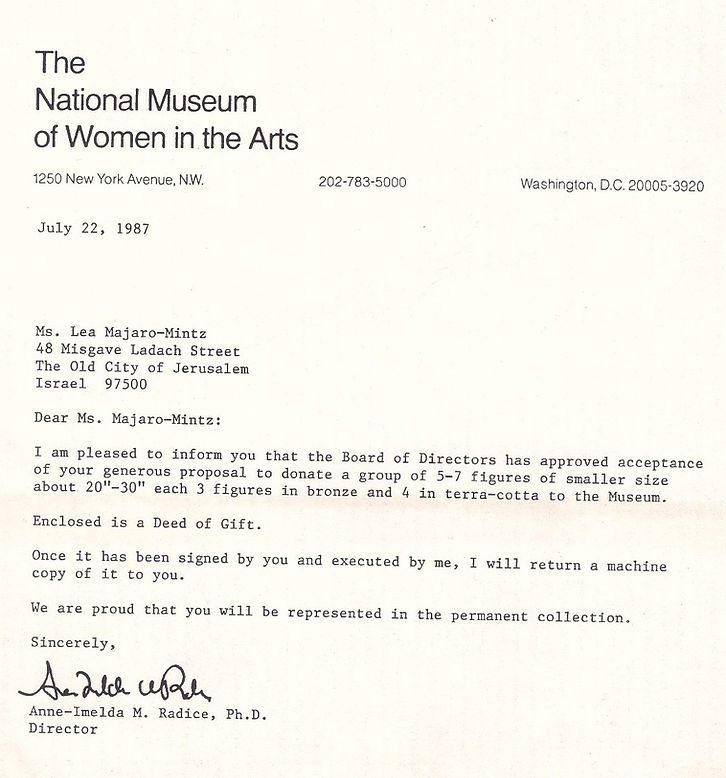
An invitation to Lea to exhibit her artworks at the National Museum of Women in the Arts in Washington

Lea installing her artworks in Washington

7. Creating Beyond Sight: The Triumph of the Spirit The deep dialogue between her hands and the clay took on a heroic, deeply literal dimension in the latter chapters of her life. Lea lost the sight in one eye in 1987, and by the year 2000, she became completely blind.

An invitation to Lea's exhibition "Tel Aviv Hidden from the Eye"
This profound loss was a direct, tragic consequence of her absolute devotion to her craft. For decades, Lea would look closely through the tiny peephole of her ceramic kiln to monitor the pyrometric cones, which indicated when the firing process had reached intense temperatures ranging from 1,000 degrees Celsius to 1,500 degrees Celsius. This constant, direct exposure to the blazing fire gradually caused severe retinal burns, ultimately taking her eyesight.
Yet, undeterred by the darkness, her internal artistic vision burned brighter than ever. She adjusted her practice entirely, navigating the canvas and the clay purely through touch, memory, and a lifetime of spatial intuition. In 2003, she debuted a historic solo exhibition at the Rokach House titled "The Invisible Tel Aviv" (Tel Aviv Ha-Smuya Min Ha-Ayin). The collection featured profound paintings and artworks created entirely after losing her sight, capturing the vibrant spirit of the city she loved through a purely internal, transcendent lens.
8. Historical Preservation, National Recognition, and Final Legacy In 1984, Lea's artistic mission had permanently merged with historical preservation when she spearheaded the extensive restoration of the historic Rokach House in Neve Tzedek, the home of her grandfather. She transformed this decaying historic landmark into a living sanctuary for her sculptures and a vibrant museum dedicated to the early history of Tel Aviv.
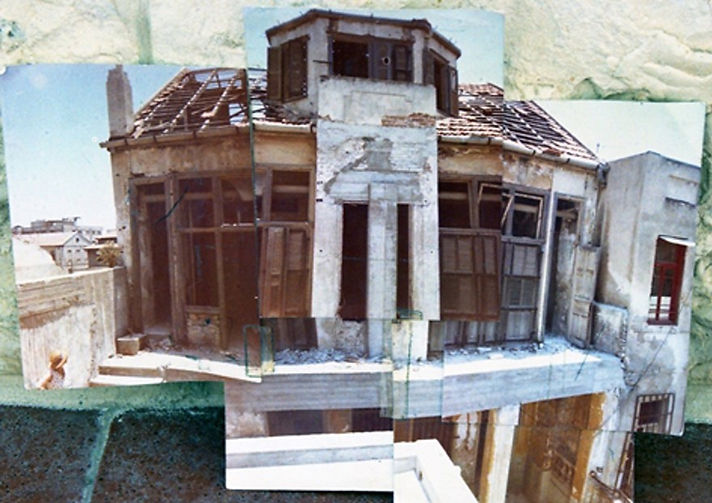
The Rokach House during its restoration in 1983

The model of the western facade of the Rokach House at the Mini Israel park, with Lea's granddaughters, Heelee and Leehee, in front of it

Her extraordinary lifelong contribution to Israeli culture, heritage, and her incredible resilience received the ultimate national recognition in 2009. She was chosen to light a torch at the official state Independence Day ceremony on Mount Herzl-one of the highest and most prestigious honors bestowed by the State of Israel.

A certificate of participation in the torch-lighting ceremony on Mount Herzl, 2009
Lea Majaro-Mintz passed away in 2022 at the age of 96, inside the very walls of Rokach House. She left behind a vast, deeply evocative body of work that stands as a testament to her enduring belief: the absolute, unbreakable fusion of the soul into the material.
"If they hadn't taught me that a baby comes from the womb, I would choose to give birth to it from clay."